


Measurement Guide
Follow these guides to get accurate measurements. Use the same method shown on our product pages for the best results.
Lay your best-fitting shirt flat on a hard surface. Button it up completely. Measure each dimension as shown below.

Measure from the center of the collar button to the middle of the buttonhole.
- Lay the shirt flat and button the top button
- Place the tape at the center of the collar button
- Measure along the inside of the collar band to the middle of the buttonhole
- Keep the tape flat against the collar band throughout

Lay the shirt flat and measure straight across from armpit seam to armpit seam.
- Lay the shirt flat on a hard surface, front facing up
- Smooth out any wrinkles — do not stretch the fabric
- Find the armpit seams on both sides
- Measure straight across from one armpit seam to the other

Lay the shirt flat and measure straight across at the natural waist point.
- Lay the shirt flat on a hard surface
- Locate the natural waist point — usually the narrowest part of the garment body, about 8–9 inches below the armpit
- Measure straight across from one side edge to the other

Measure straight across the back from one shoulder seam to the other.
- Lay the shirt flat, back facing up
- Locate the shoulder seams where the sleeve attaches to the body
- Measure straight across from the end of one shoulder seam to the other
- The tape should follow the yoke — not drape over the collar

Measure from the center of the back yoke to the end of the sleeve.
- Button up the shirt front and cuffs completely
- Lay the shirt face-down so the back is visible
- Pull one sleeve away until it is fully extended and flat
- Place the tape at the center of the back yoke
- Measure straight along the sleeve to the end of the cuff

Measure from the base of the collar to the bottom hem.
- Lay the shirt flat, front facing up
- Place the tape at the junction of the collar and the back yoke
- Measure straight down to the bottom of the hem
- Measure at the center back, not the side

Lay the sleeve flat and measure across the widest part of the upper arm area.
- Lay the shirt flat with one sleeve extended
- Find the widest point of the sleeve — about 1 inch below the armpit seam
- Measure straight across from one edge to the other
- Keep the sleeve completely flat, not stretched
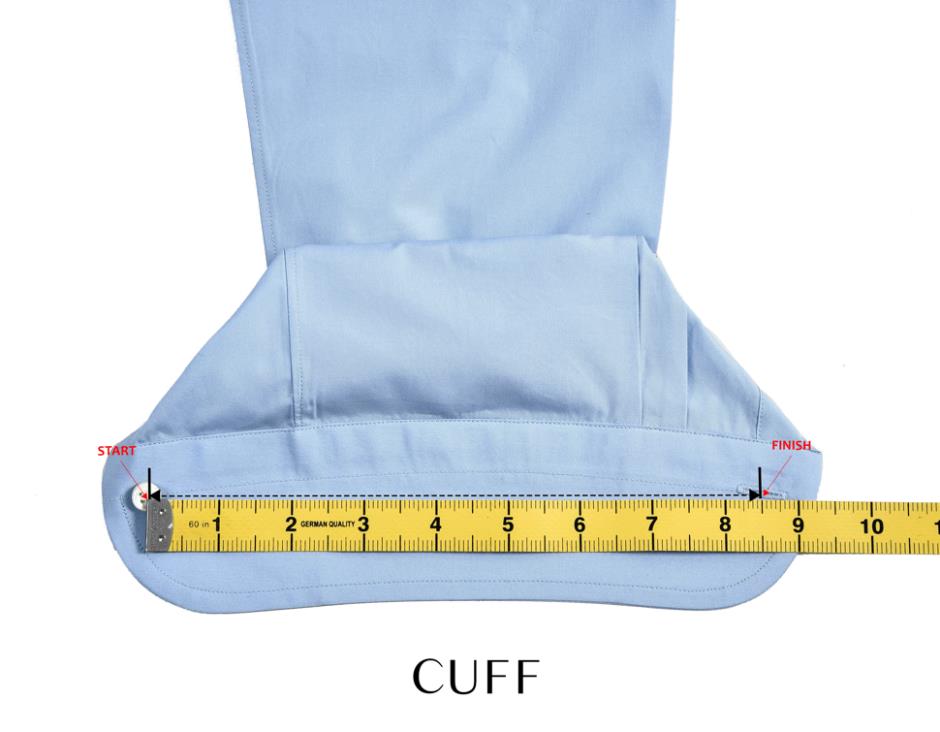
Measure from the center of the cuff button to the middle of the buttonhole.
- Spread the cuff out flat on a hard surface
- Place the tape at the center of the cuff button
- Measure straight across to the middle of the buttonhole
- Keep the cuff in its natural open position while measuring
Measure your body wearing fitted underwear or a thin layer. Keep the tape snug but not tight. Have someone help for the best accuracy.

Measure around the base of your neck where a shirt collar would sit.
- Stand naturally and look straight ahead
- Wrap the tape around the base of your neck, just above the collarbone
- Keep the tape snug but comfortable — you should be able to slide two fingers underneath
- Take the reading at the front of your throat

Measure around the fullest part of your chest, under your arms.
- Stand naturally with your arms relaxed at your sides
- Wrap the tape around the fullest part of your chest — usually across the nipple line
- Keep the tape level all the way around, including across your shoulder blades
- Breathe normally — do not puff out or compress your chest

Measure around your natural waist, keeping the tape close to your skin.
- Stand naturally — do not suck in your stomach
- Find your natural waist (at navel level, the narrowest part of your torso)
- Wrap the tape around your waist, keeping it level all the way around
- The tape should be snug but not digging in

Measure straight across from one shoulder point to the other.
- Stand naturally with your arms at your sides
- Locate the bony point at the top of each shoulder
- Measure straight across your upper back from one shoulder point to the other
- Keep the tape flat against your body

Measure from the shoulder point down to where you want the cuff to end.
- Stand with your arm relaxed and slightly bent
- Start at the bony point on top of your shoulder
- Run the tape down over your elbow to your wrist bone
- The tape should follow the natural bend of your arm
Measure from the base of the back of your neck straight down to where you want the shirt to end.
- Stand straight and have someone place the tape at the prominent bone at the base of the back of your neck
- Measure straight down your back to where you want the shirt hem to end
- For tucked shirts: measure to about 4 inches below your belt line
- For untucked shirts: measure to about mid-fly level

Measure around the fullest part of your upper arm.
- Stand with your arm relaxed at your side
- Find the fullest part of your bicep — usually midway between shoulder and elbow
- Wrap the tape around the arm at that point
- Keep the tape snug but not compressing
Measure around your wrist at the wrist bone.
- Wrap the tape around your wrist at the wrist bone (the bony protrusion on the outer side)
- Keep the tape snug against your skin
- Record the circumference
Lay your best-fitting pants flat on a hard surface. Button/clasp the waistband closed. All measurements below are flat (half) unless noted otherwise.

Measure exactly from one end of the waist side seam to the other.
- Lay your pants flat on a hard surface
- Button or clasp the waistband closed
- Measure straight across the top of the waistband from one side seam to the other
- Keep the tape flat and straight

Go up ½ inch from the fly line point. Measure straight across.
- Lay your pants flat on a hard surface
- Locate the bottom of the fly/zipper
- Move up ½ inch from that point toward the waistband
- At that level, measure straight across from one side edge to the other

Go down 2 inches from the crotch point and measure straight across.
- Locate the crotch seam point
- Measure down 2 inches from the crotch along the inseam
- At that point, measure straight across from one side edge to the other
- Make sure the pant leg is lying completely flat

Fold the pant leg so the hem meets the crotch — measure 1 inch above the fold.
- Fold one pant leg so the bottom hem meets the crotch point
- The fold line is approximately your knee point
- Unfold and measure 1 inch above that fold line
- Measure straight across from one side edge to the other

Measure straight across the bottom hem opening.
- Lay the pant leg flat on a hard surface
- Smooth out the bottom hem area
- Measure straight across the hem opening from one edge to the other

Measure from the crotch point straight up to the top of the front waistband.
- Locate the crotch point — where the inseam meets the front of the pant
- Place the end of the tape at the crotch seam
- Measure straight up to the top of the front waistband (at the center front)

Flip the pants over. Measure from the crotch point to the top of the back waistband.
- Flip the pants so the back is facing up
- Locate the crotch point
- Place the end of the tape at the crotch seam
- Measure straight up to the top of the back waistband (at the center back)

Measure from the crotch point to the bottom hem along the inside seam.
- Lay one leg flat, smoothing out any wrinkles
- Locate the crotch seam
- Place the end of the tape right at the crotch seam
- Measure along the inside seam down to the bottom hem

Measure from the top of the waistband down the side seam to the bottom hem.
- Locate the top of the waistband on the side seam
- Place the tape at the top of the waistband
- Measure down along the outside seam to the bottom hem
Measure your body wearing fitted underwear. Stand naturally on a flat, hard surface. Have someone help for the best accuracy.
Wrap the tape around your waist at your navel level.
- Stand naturally — do not suck in your stomach
- Find your natural waist (the narrowest part of your torso)
- Wrap the tape around, keeping it level all the way
- Snug but not digging in — you should be able to slide a finger underneath

Wrap the tape around the fullest part of your hips/seat.
- Stand with your feet together
- Find the widest part of your hips — about 7–8 inches below your waist
- Wrap the tape around the fullest point, keeping it level and parallel to the floor

Measure around the fullest part of your thigh, about 2 inches below the crotch.
- Stand with weight evenly distributed
- Place the tape about 2 inches below your crotch
- Wrap the tape around your thigh, keeping it level
- Keep the tape snug — do not squeeze

Wrap the tape around your knee at the center of your kneecap.
- Stand straight with leg slightly bent
- Find the center of your kneecap
- Wrap the tape around at that point
- Keep the tape level and snug

Stand straight. Measure from your crotch to the floor.
- Stand straight with feet shoulder-width apart on a flat, hard surface
- Place the tape at your crotch point
- Let the tape fall straight down to the floor along the inside of your leg
- Have someone else read the measurement

Stand straight. Measure from your waist to the floor along the outside of your leg.
- Stand straight on a flat, hard surface
- Place the tape at your natural waist on the side of your body
- Let the tape fall straight down along the outside of your leg to the floor
- Keep the tape close to your body but straight
Lay your best-fitting jacket flat on a hard surface. Button it closed. All measurements below are flat (half) unless noted otherwise.

Measure straight across the back from one shoulder point to the other.
- Lay the jacket flat, back facing up
- Locate the shoulder seams on both sides
- Measure straight across from end of one seam to the other
- The tape should follow the yoke line

Measure straight across the chest from armpit seam to armpit seam.
- Lay the jacket flat, front facing up
- Button the jacket closed
- Find the armpit seams on both sides
- Measure straight across

Measure straight across at the waist button level.
- Lay the jacket flat, front facing up
- Button the jacket closed
- Measure straight across at the waist button level
- Keep the fabric smooth and flat

Measure straight across about 7 inches below the waist.
- Lay the jacket flat, button it closed
- Measure about 7 inches below the waist button
- Measure straight across from one side edge to the other

Measure from the shoulder seam to the end of the sleeve.
- Lay the jacket flat with one sleeve extended
- Place the tape at the shoulder seam
- Measure along the top of the sleeve down to the end of the cuff
- Keep the tape straight

Measure from the base of the collar to the bottom hem at the center back.
- Lay the jacket flat, back facing up
- Place the tape at the junction of the collar and the back seam
- Measure straight down to the bottom edge
- Measure at center back — not at the side or vent
Measure your body wearing a thin layer. Have someone help for accuracy, especially for shoulder and back measurements.

Measure around the fullest part of your chest, under your arms.
- Stand naturally with arms relaxed
- Wrap the tape around the fullest part — usually across the nipple line
- Keep the tape level all the way around
- Breathe normally

Measure around your natural waist.
- Stand naturally
- Find your natural waist (the narrowest part of your torso)
- Wrap the tape around, keeping it level
- Snug but not tight

Measure around the fullest part of your hips.
- Stand with feet together
- Find the widest part of your hips/seat
- Wrap the tape around the fullest point, level and parallel to the floor

Measure straight across from one shoulder point to the other.
- Stand naturally with arms at your sides
- Locate the bony point at the top of each shoulder
- Measure straight across your upper back from one point to the other
- Follow the natural curve of your shoulders

Measure from the shoulder point down to where you want the jacket cuff to end.
- Stand with arm relaxed and slightly bent
- Start at the bony point on top of your shoulder
- Run the tape down over your elbow to where you want the sleeve to end
- The tape should follow the natural bend of your arm

Measure from the base of the side neck down the front to where you want the jacket hem to end.
- Stand naturally and look straight ahead
- Place the tape at the base of your neck on the side
- Run the tape straight down the front to the desired hem point
- The tape should hang straight — do not follow body contours
Need help with measurements?
Email us at mail@luxire.com with your best-effort measurements and we'll review them before cutting. You can also send us a garment and we'll measure it for you.